blog
.avif)
Why Homes Near Highways Need Solar Panel Cleaning More Often
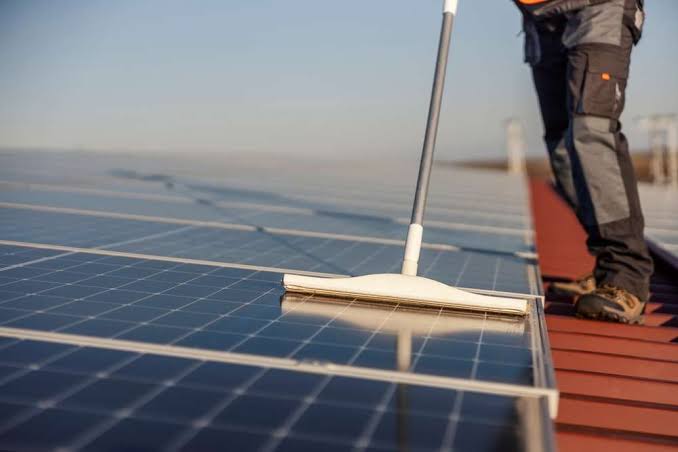
The location of your home relative to major roads and highways has a direct and often underappreciated effect on how quickly your solar panels accumulate the kind of buildup that reduces their efficiency. For Texas homeowners whose properties sit near Interstate highways, major arterial roads, or other high-traffic corridors, understanding this location-specific maintenance consideration helps you establish a cleaning schedule that actually accounts for your panels' real-world accumulation rate rather than following generic guidelines designed for average conditions.
How Highway and Road Proximity Affects Solar Panel Accumulation
Vehicle Exhaust Deposits Fine Particulate Matter
Modern vehicle combustion produces fine particulate matter as a byproduct, and while emissions standards have improved dramatically, high-traffic roads still generate meaningful quantities of airborne particles from the cumulative effect of thousands of vehicles passing daily. These particles, a mixture of carbon compounds, rubber dust from tire wear, brake dust, and combustion byproducts, become suspended in the air adjacent to highways and settle on surfaces downwind of the traffic corridor.
Solar panels directly in the downwind path of a highway or major arterial road receive these particles continuously throughout the day and night whenever traffic is flowing, which near major Fort Worth highways means essentially around the clock. This continuous deposition accelerates accumulation rates significantly compared to panels on properties distant from major traffic sources.
Road Dust From Unpaved Shoulders and Disturbed Soil
In addition to exhaust particulates, high-traffic roads generate dust from tire interaction with road shoulders, adjacent disturbed soil, and construction activity that's perpetually ongoing somewhere along any major Texas highway corridor. This coarser road dust settles on surfaces within the plume area extending downwind from the traffic corridor, adding to the exhaust particle accumulation on panels in these locations.
Rubber and Tire Compound Deposits
Tire wear deposits rubber and compound particles onto road surfaces that subsequently become airborne as traffic disturbs them. These rubber particles have adhesive properties that cause them to bond more tenaciously to surfaces they contact, including solar panels, than simple dust particles that might be partially rinsed by rainfall.
How Much Faster Do Highway-Adjacent Panels Get Dirty
The specific accumulation rate difference between highway-adjacent and typical residential properties varies based on distance from the traffic source, prevailing wind direction, local topography, and the specific traffic volume of the nearby road. What's consistent is that the direction is always the same: more traffic exposure equals faster accumulation equals reduced panel efficiency arriving sooner after each cleaning than it would for equivalent panels in lower-traffic locations.
Homeowners with production monitoring systems who live near major roads can often see this accumulation effect reflected in their production data, where output decline between cleanings happens more rapidly than the standard efficiency guidance would predict.
Fort Worth Specific Highway Corridors Worth Noting
Fort Worth's extensive highway network, including Interstates 35W, 30, 20, and 820 along with major arterials like Highway 377 and Loop 820, creates substantial traffic corridor exposure for many residential properties within the city. The continued growth of the Fort Worth metro area means highway construction and traffic volume increases are ongoing factors that affect an expanding zone of residential solar installations near these corridors.
Adjusting Your Cleaning Schedule for Highway Proximity
More Frequent Cleaning Protects Your Production Baseline
For properties near major roads, adjusting from a standard twice-yearly cleaning to three or four times per year reflects the real accumulation rate these panels experience rather than applying a schedule designed for average conditions that don't match your location's actual exposure level.
Monitoring Output to Calibrate Your Specific Schedule
The most precise approach to scheduling for highway-adjacent properties is monitoring your production data for the specific rate at which output declines after each cleaning. This property-specific observation gives you accurate data about how quickly accumulation affects your panels in your specific location, allowing you to schedule cleaning precisely when efficiency loss justifies it rather than following a calendar that may be either too frequent or not frequent enough for your specific conditions.
Post-Cleaning Production Recovery as a Calibration Signal
Tracking how much production recovers immediately after cleaning, compared to the pre-cleaning level, gives you a direct measurement of how much efficiency the accumulated buildup was costing you. Large recoveries after cleaning indicate significant pre-cleaning efficiency loss, suggesting your schedule should be more frequent. Modest recoveries suggest cleaning frequency is approximately right for your accumulation rate.

The Phillips Approach to Location-Specific Maintenance
At Phillips Exterior Cleaning, the service area covering Fort Worth and Saginaw includes properties across a wide range of proximity to the area's major highway corridors, and the cleaning recommendations made for specific properties account for location-specific exposure factors rather than applying a generic schedule universally. If your home is near a major road and you've noticed your panels seem to get dirty faster than your neighbor's in a quieter location, your observation is correct and your cleaning schedule should reflect it.
Schedule your solar panel cleaning quote here.

Detail You Can See. Quality You Can Trust.
Contact Us


Find us on


