blog
.avif)
What Happens to Solar Panels That Go Years Without Cleaning
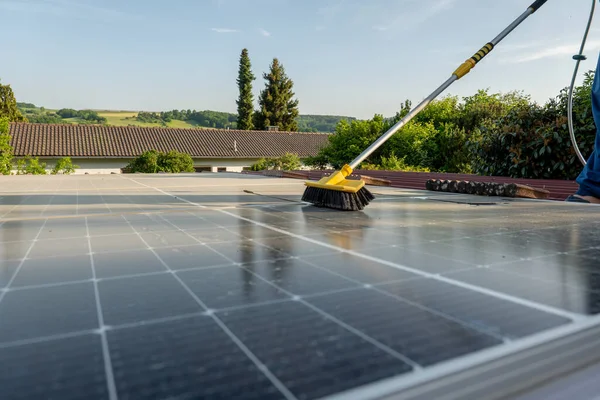
Most discussions of solar panel cleaning focus on the efficiency benefits of regular maintenance. Fewer address the specific question of what actually happens to panels that go years without any professional cleaning at all, which is unfortunately the maintenance history of a meaningful number of residential solar installations. Understanding the progressive, compounding effects of extended cleaning neglect on solar panel performance and condition makes the case for consistent maintenance more concretely than general efficiency statistics alone.
Year One Without Cleaning: The Gradual Accumulation Phase
Pollen Season Deposits the First Significant Layer
For most Texas solar installations, the first significant buildup event in a year without cleaning is pollen season. The yellow-green film that Texas spring pollen deposits on every outdoor surface creates the first substantial light-blocking layer on panels that went into the year clean at installation or from a previous cleaning.
Summer Dust and Heat-Baking Compounds the Layer
Through summer, atmospheric dust and traffic-generated particulates accumulate on top of the pollen film, and Texas heat repeatedly cycles through high temperatures that progressively bond these accumulation layers more firmly to the glass surface. By the end of the first year without cleaning, a panel that entered the year clean has developed a multi-layer contamination film that's meaningfully more resistant to removal than it would have been at any earlier point in the accumulation cycle.
Efficiency Loss Is Measurable but Recoverable
After one year without cleaning, efficiency loss from contamination is typically measurable in production monitoring data, and a professional cleaning at this point fully restores panel performance. The glass itself has not been permanently affected, and cleaning removes the accumulated layer completely.
Year Two Without Cleaning: Compounding and Bonding
Second Pollen Season Adds to an Already Dirty Surface
The second pollen season without cleaning deposits fresh pollen on top of the previous year's accumulation rather than on clean glass. The sticky quality of pollen causes it to adhere more tenaciously to existing contamination than to clean glass, creating a denser, more compact accumulation layer that's correspondingly harder to remove than either year's pollen film would have been separately.
Mineral Deposits Begin Building Into a Meaningful Film
Two years of rain events, sprinkler overspray, and dew cycles each depositing mineral residue as they evaporate creates a mineral deposit layer that has built from barely visible spotting into a film with enough optical density to meaningfully scatter and block light across a substantial portion of the panel surface.
Bird Activity Creates Permanent-Looking Deposits
Bird droppings that have been on a panel surface through two Texas summers have experienced enough heat cycling to bond to the glass more firmly than relatively fresh deposits. While professional cleaning can still address these at this stage, it may require more targeted treatment than a standard cleaning pass provides.
Year Three and Beyond: When Permanent Damage Becomes a Risk
Hard Water Mineral Etching Begins to Develop
This is the threshold where cleaning neglect transitions from reduced efficiency to potential permanent glass damage. Hard water mineral deposits that have been on panel glass surfaces through three or more cycles of heat and moisture begin to chemically etch into the glass surface itself rather than simply sitting on top of it. Unlike surface contamination that professional cleaning removes completely, etching represents physical change to the glass that cleaning may improve but cannot fully reverse.
Anti-Reflective Coating Degradation Compounds With Contamination
Solar panel anti-reflective coatings are designed to enhance light transmission into the cells. Extended contamination that sits on these coatings through multiple Texas summers degrades the coating's optical properties through both chemical interaction with the contamination layer and the abrasive effect of repeated thermal cycling with grit and mineral material on the coating surface. This coating degradation reduces panel efficiency in a way that cleaning addresses only partially, since the coating itself has been changed.
Biological Growth Establishes Persistent Colonies
Algae and other biological growth that's been present on panel glass for multiple years without treatment establishes itself in the microscopic texture of the glass surface in a way that single-season biological growth doesn't. Extended biological presence creates more persistent contamination that standard cleaning addresses less completely than it would address the same growth removed after a single season.
The Financial Cost of Extended Neglect
Compounding Efficiency Loss Over Multiple Years
Each year of cleaning neglect builds efficiency loss on top of the previous year's reduced performance, creating a compounding decline rather than a stable reduced level. A panel that lost five percent efficiency in year one is not simply continuing to perform at 95 percent in year three, it's performing at the reduced level of year three's total accumulated contamination, which represents more than three times year one's loss for most accumulation patterns.
Cleaning Costs More After Extended Neglect
Professional cleaning of panels that haven't been cleaned in multiple years requires more intensive treatment, sometimes multiple passes, targeted mineral and biological treatment, and more labor time than annual maintenance cleaning. The per-visit cost of a multi-year catch-up cleaning exceeds the cost of the regular maintenance cleanings that would have kept the panels clean over the same period.

The Lesson From Extended Neglect
The specific, progressive nature of what happens to solar panels without cleaning over multiple years makes a compelling case for consistent annual or twice-yearly professional maintenance rather than indefinite deferral. The efficiency recovery from cleaning panels maintained annually is complete. The efficiency recovery from panels neglected for multiple years is partial, and the glass may carry some permanent optical effects from that neglect regardless of subsequent cleaning quality.
Schedule your solar panel cleaning quote here.

Detail You Can See. Quality You Can Trust.
Contact Us


Find us on


