blog
.avif)
What Dirty vs. Clean Solar Panels Actually Look Like
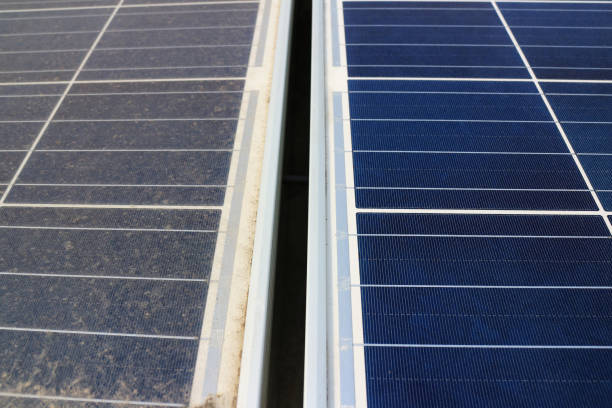
One of the challenges with solar panel maintenance is that the efficiency reduction from dirty panels isn't directly visible from the ground in the same way that a dirty window or stained driveway is immediately obvious to a casual observer. But there are specific visual indicators that panels need cleaning that become recognizable once you know what to look for, and understanding the visual difference between dirty and clean panels helps you assess your own system's condition more accurately than guessing based on how long it's been since the last service.
What Clean Solar Panels Look Like
Uniform Dark Color Across All Cells
Clean solar panels present a uniform, consistently dark appearance across the entire panel surface, whether that's the deep blue-black of monocrystalline cells or the slightly less uniform appearance of polycrystalline cells. This uniformity of color and surface appearance across every section of every panel is the baseline condition that maximum efficiency requires.
Reflective Glass Surface
Clean solar panel glass has a characteristic subtle reflectivity that reflects surrounding sky and environment clearly in the way clean glass does, without the diffused, hazy reflection that a contaminated surface produces. Looking at clean panels at certain angles, you'll see a relatively clear reflection of the sky above rather than a dull, muted surface.
No Visible Deposits or Discoloration
At close range, clean panels show no visible deposits, discoloration patterns, or surface irregularities beyond the cell structure itself. The anti-reflective coating on clean glass has a consistent, subtle appearance across the entire surface without the localized variations that mineral deposits, bird droppings, or pollen accumulation create.
What Dirty Solar Panels Look Like
The Pollen Film Appearance
Panels that have been through a Texas spring pollen season without cleaning develop a distinctive yellowish-green tint across the glass surface that's often visible from the ground during the height of pollen season and remains as a more subtle but still efficiency-reducing haze after the obvious yellow color fades. Up close, this appears as a fine particulate film over the glass surface that obscures the clean, clear appearance of the glass beneath.
Dust and Atmospheric Accumulation
Gradual dust accumulation appears as a general dulling of the panel surface that reduces the glass's reflective quality and gives it a matte appearance rather than the clean glass look of properly maintained panels. This type of accumulation is often not obvious from a distance but becomes clear when comparing a dusty panel to a recently cleaned one side by side.
Bird Dropping Patterns
Bird droppings on solar panels are among the most visually obvious forms of contamination and also among the most efficiency-impacting. Fresh droppings appear as white spots of varying size on the dark panel surface. Older droppings dry and potentially develop a brown or gray crust that becomes progressively harder to remove the longer it sits. The visual pattern of droppings concentrated along certain panel edges or in specific locations often indicates nearby perching points that birds use regularly, creating predictable dropping patterns rather than random distribution.
Hard Water Mineral Deposits
Hard water deposits on solar panels appear as white or gray circular or irregular spots, often with a slightly chalky or crystalline appearance, that correspond to water drop evaporation patterns. Sprinkler overspray hitting panels creates particularly recognizable hard water deposit patterns that show the spray arc shape in the deposit distribution. These deposits can range from subtle spotting that's barely visible from the ground to significant white haze covering substantial panel areas in heavy cases.
The Streak Pattern From Rain Without Cleaning
An interesting visual pattern develops on panels that experience rain but no professional cleaning over time: streak patterns running from top to bottom that correspond to water flow paths down the panel surface, carrying dust and debris with them as they drain and depositing it in concentrated streaks rather than uniform coverage. This streak pattern is often visible on panels that look clean from directly below but show obvious contamination from a side angle where the directional streaking is apparent.
How to Assess Your Own Panels From the Ground
The Side-Angle View
Looking at your panels from a low angle, viewing them more from the side than directly from below, reveals surface contamination that's often invisible when looking straight up at the panels. The haze and deposit patterns that reduce efficiency become more visible at this low angle where light reflects differently off contaminated versus clean surfaces.
Comparing Panels Within the Same Array
If your array includes panels with different exposure levels, perhaps some shaded by a chimney for part of the day and others in full sun, comparing the visual appearance between panels with different exposure can reveal contamination patterns correlated with the different environmental conditions each panel experiences.
Production Data as the Most Reliable Indicator
While visual assessment provides useful information, your solar monitoring system's production data is the most reliable indicator of whether contamination has reached a level that's meaningfully affecting performance. A production decline that can't be explained by weather or seasonal factors is a stronger cleaning signal than visual assessment alone, particularly for contamination types that aren't obvious from ground-level visual inspection.

The Visual Difference Is Worth Seeing
If you've never seen your panels immediately after a professional cleaning compared to their pre-cleaning appearance, the difference in glass clarity and surface uniformity is often striking, particularly for panels that haven't been cleaned in a year or more. Clean panels that look the way they did when installed, with clear, uniform glass surfaces free of deposits and discoloration, are performing panels.
Schedule your solar panel cleaning quote here.
Detail You Can See. Quality You Can Trust.
Contact Us


Find us on


