blog
.avif)
What Attracts Mud Daubers to Your Home in Fort Worth
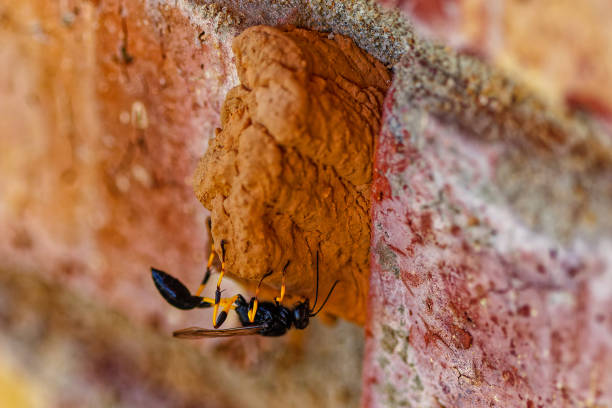
Mud daubers are among the most commonly encountered wasp species around Fort Worth and Saginaw area homes, and their distinctive mud tube nests appear on home exteriors with a frequency that surprises many homeowners who haven't dealt with them before. Understanding what specifically attracts mud daubers to residential properties helps explain both why these nests appear where they do and what conditions create particularly active mud dauber presence on certain homes.
What Mud Daubers Are and Why They Build on Homes
Solitary Wasps With a Specific Building Requirement
Unlike social wasps such as paper wasps and yellow jackets that build colony nests defended by worker populations, mud daubers are solitary wasps where each female constructs and provisions her own individual nests. This solitary nature is part of why mud daubers are generally non-aggressive compared to social wasps, since there's no colony defense instinct driving sting behavior.
Mud dauber females construct their characteristic clay or mud tubes as nest chambers that they fill with paralyzed spiders as food for their larvae, then seal the tube once it's provisioned. Each tube is a self-contained nursery rather than a social colony structure, and multiple tubes built in the same area represent multiple individual females who've found that location favorable rather than a single expanding colony.
Why Homes Provide Ideal Nest Sites
Home exteriors provide mud daubers with the sheltered, protected surfaces they specifically seek for nest placement. The requirements for mud dauber nest placement are straightforward: a protected, relatively smooth surface shielded from direct rain and excessive sun, near a supply of damp mud for construction material, and near an adequate spider population to provision the nest chambers.
Eaves, soffits, porch ceilings, wall corners near the roofline, window and door frames, and the undersides of awnings all provide the sheltered, rain-protected surfaces that mud daubers prefer. Homes with extensive overhangs, covered porches, and other sheltered exterior surfaces offer more qualifying nest sites than homes with minimal overhead protection.
Specific Conditions That Increase Mud Dauber Attraction
Moisture Sources for Mud Collection
Mud daubers need damp clay-like soil to construct their tubes, and they collect construction material from sources within reasonable foraging range of their nest site. Properties with consistently moist soil near the foundation, irrigation systems that keep garden beds and lawn areas damp, ornamental ponds, or other reliable moisture sources near the home create favorable mud collection conditions that support active mud dauber construction activity.
High Spider Populations Near the Structure
Since each mud dauber tube must be provisioned with multiple paralyzed spiders, homes with high spider populations in and around their exterior structure provide the food source that supports robust mud dauber activity. This creates a direct connection between general spider activity around a home and subsequent mud dauber activity, since mud daubers follow their spider prey supply when selecting nest areas.
Previous Nest Sites Signal Favorable Conditions
Mud daubers show a tendency to build new nests near previous successful nest sites, using existing tubes or nearby areas as indicators of suitable conditions. Once mud dauber nests have established on a particular area of your home's exterior, subsequent seasons often bring new construction in the same or adjacent locations unless the area is thoroughly cleaned and conditions that attracted the initial activity are modified.
Textured or Rough Exterior Surfaces
Mud dauber tubes adhere most successfully to surfaces with some texture that provides mechanical grip for the clay material. Rough stucco, brick, unpainted concrete, and weathered wood surfaces attract more mud dauber construction activity than smooth, painted, or sealed surfaces where the clay tubes have less surface texture to adhere to.
How Professional Bug Removal Addresses Mud Daubers
Complete Tube Removal Including Residue
Effective mud dauber removal removes not just the visible tube structures but also the adhesive residue and any partial tubes that remain after tube removal. Leaving residue on the surface both reduces the aesthetics of the result and leaves chemical traces that may contribute to subsequent activity in the same location.
Addressing the Conditions That Attracted Activity
The most complete approach to mud dauber management combines professional removal of existing structures with attention to the conditions that made the specific location attractive: reducing the spider populations that provide their food source through comprehensive spider web removal, and where practical, modifying moisture conditions that support mud collection near the structure.

Managing Mud Daubers as Part of Comprehensive Bug Removal
Mud dauber nest removal is most effectively approached as part of comprehensive exterior bug removal that addresses the full range of spider, insect, and pest activity on the home's exterior simultaneously, since the spider populations that attract mud daubers and the same sheltered eave and soffit conditions that attract web-building spiders represent overlapping conditions that a single comprehensive service addresses more completely than targeted single-species treatment.
Request your spider web and bug removal quote here.

Detail You Can See. Quality You Can Trust.
Contact Us


Find us on


