blog
.avif)
How to Remove Tire Marks and Oil From Your Driveway
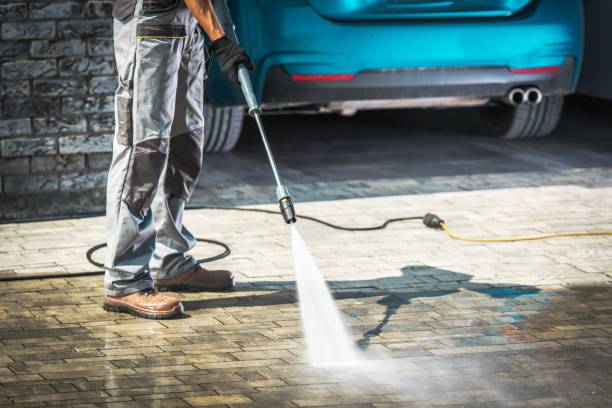
Of all the staining types that accumulate on residential driveways, tire marks and oil deposits are among the most visually prominent and the most resistant to standard cleaning attempts. These petroleum-based stains don't respond to a simple rinse or even standard household cleaners, and they tend to darken and spread over time if left unaddressed, turning what started as a minor cosmetic issue into a driveway that looks consistently neglected regardless of how well-maintained the rest of your property is.
Why Tire Marks Form on Concrete Driveways
Heat Activates Tire Compound Transfer
Tire marks on concrete driveways form primarily during hot weather when tire compounds, the chemical mixture that gives rubber tires their grip and flexibility, become temporarily softened by heat and transfer directly onto the driveway surface during acceleration, braking, and turning movements. Texas summers create the extended high-temperature conditions that make tire mark formation particularly common, since heat-softened tire compounds transfer more readily than the same tires on cooler pavement.
Acceleration and Braking Points See the Most Marking
The areas of your driveway where vehicles accelerate away from a stop and where they slow for turning movements experience the most tire compound transfer, which is why tire marks tend to concentrate at driveway entrances, turning areas, and garage approach zones rather than being distributed evenly across the entire surface.
Marks Darken Over Time From Oxidation
Fresh tire marks are often a relatively light gray color that's easy to overlook. As these marks age, the tire compound oxidizes and darkens, making marks that were barely noticeable when fresh become significantly more prominent over weeks and months of weathering, which is why driveways that seemed fine in spring can look noticeably marked by midsummer.
Why Oil and Automotive Fluid Stains Are Even More Stubborn
Oil Penetrates Concrete's Porous Structure
As established in earlier guides, concrete is a porous material that absorbs liquids readily. Oil and automotive fluid that drips onto a driveway surface doesn't just sit on top, it penetrates into the concrete's pore structure where it becomes increasingly difficult to remove the longer it's allowed to sit and migrate deeper into the material.
Multiple Fluid Types Create Different Stain Characteristics
Vehicle driveways don't just see motor oil. Transmission fluid, power steering fluid, brake fluid, coolant, and fuel all have different chemical compositions that create different stain colors and respond differently to cleaning treatments. A brownish-black stain near the front of a parking spot behaves differently from a reddish transmission fluid stain or a colorless coolant deposit, and effective treatment accounts for these differences rather than applying a uniform approach.
Heat-Baked Oil Becomes Progressively Harder to Remove
Oil that penetrates into concrete and then experiences repeated cycles of Texas summer heat essentially gets cooked deeper into the pore structure with each hot day, making stains that have been present through multiple Texas summers significantly more resistant to removal than fresh deposits. This is the primary reason that addressing oil stains promptly produces meaningfully better results than waiting until a deep clean is eventually scheduled.
Why Standard DIY Cleaning Falls Short
Household Degreasers Aren't Formulated for Concrete
Consumer degreasers designed for kitchen surfaces, appliances, and general household grease removal aren't formulated for the specific chemistry of automotive petroleum products absorbed into porous concrete. They may lift surface-level residue while leaving the absorbed portion entirely unaffected, producing results that look improved immediately after cleaning but fade back toward the original stain appearance as surface cleaning product evaporates.
Pressure Without Pre-Treatment Redistributes Rather Than Removes
Using a pressure washer on oil and tire mark stains without appropriate pre-treatment primarily redistributes the surface-level contamination rather than removing it, often spreading staining into a larger but lighter-appearing area rather than genuinely lifting the material out of the concrete's pore structure.
How Professional Power Washing Addresses These Stains
Commercial-Grade Degreasing Pre-Treatment
Professional power washing for tire marks and oil stains begins with application of commercial-grade degreasing solutions specifically formulated to penetrate into concrete pores and chemically break down petroleum-based contamination at a molecular level. This pre-treatment is what separates professional results from DIY attempts: the degreasing chemistry does the work of loosening the contamination from within the concrete before pressure washing lifts and removes it.
Hot Water Pressure Washing for Petroleum Stains
Some professional power washing systems use heated water specifically for petroleum-based stains, since elevated water temperature enhances the effectiveness of degreasing chemistry and increases the ability to emulsify oil and lift it from concrete surfaces. This hot water capability is a meaningful professional advantage for petroleum stain removal specifically.
Multiple Treatment Passes for Established Stains
Long-standing oil stains that have penetrated deeply through multiple seasons of heat cycling may require multiple pre-treatment and washing passes to fully address, with the depth of penetration determining how many treatment cycles are needed to lift contamination from the full depth of the affected zone.
Protecting Your Driveway After Cleaning
Sealing your driveway after professional cleaning, as covered in the concrete sealing guide, creates a surface barrier that makes future oil and tire mark staining significantly easier to clean before it penetrates as deeply as unprotected concrete allows, protecting the cleaning investment you've just made and reducing the severity of future staining.

Restore Your Driveway's Appearance
Oil stains and tire marks don't have to be permanent features of your driveway. Professional power washing with appropriate degreasing pre-treatment addresses even stubborn, established petroleum staining more thoroughly than any DIY approach, delivering a result that genuinely improves how your entire property presents from the street.
Request your power washing quote here.

Detail You Can See. Quality You Can Trust.
Contact Us


Find us on


