blog
How to Know If Your Boat Dock Is Safe Before Summer Season Starts

The first warm weekend of the year when lake conditions invite the whole family down to the dock is not the moment you want to discover that your dock has a safety problem. Yet this is exactly when many Texas lake homeowners first notice that something isn’t right with their dock, because summer’s arrival is when dock use goes from occasional to daily and when any conditions that compromise safety become immediately relevant in a way they weren’t during the quieter off-season months.
A straightforward pre-season safety assessment, done before the first family gathering at the water, is one of the most practical things a lake homeowner can do each spring. Here’s what to look for and what the findings mean.
Why Pre-Season Assessment Matters More Than It Seems
Off-Season Conditions Accelerate Dock Deterioration
During the quieter fall and winter months when dock use is minimal, deterioration processes continue on the dock structure without the regular observation that active-use seasons naturally provide. Wood rot advances. Hardware corrodes. Algae establishes itself on surfaces. Structural connections that were borderline at the end of last season have had additional months to weaken further.
The dock you left at the end of last summer is not necessarily the same dock you’re returning to this spring, even though it looks similar from a distance. A specific pre-season assessment that looks beyond surface appearance at the structural elements that determine whether the dock is genuinely safe to use is the only reliable way to know what you’re actually returning to.
High-Use Season Puts Maximum Stress on Everything
Summer dock use involves more people, more weight, more movement, and more dynamic activity than the occasional quiet visit that characterizes off-season use. A structural connection that holds adequately for one careful adult walking to the dock’s end may not hold adequately for three children running, a group of adults gathered at the edge watching a boat dock, or the concentrated weight of people jumping from the dock into the water.
Assessing safety under off-season conditions where the dock is seeing minimal use can miss vulnerabilities that only become apparent under the greater stress of active summer use, which is why pre-season assessment that specifically considers the load conditions of summer use produces more useful safety information than casual observation during quiet months.
The Pre-Season Safety Assessment: What to Check
Start With the Approach and Entry Point
Before stepping onto the dock itself, assess the approach and entry point from the shore. The gangway, the first steps onto the dock structure, and any transition between shore and floating or fixed dock sections are the access points that every person who uses the dock must pass through, often while carrying equipment, holding children’s hands, or navigating with less attention to footing than they’d give to open dock surface.
Check that the gangway is firmly attached at both ends, that any transition hardware is intact and secure, and that the surface of the approach area is free of algae and biological growth that would create slip conditions at the exact point where balance and footing are most critical.
Walk Every Section of the Walking Surface
Walk the entire dock surface systematically, not just the main path to the end but every section including edges, corners, and any platforms or extensions, paying specific attention to how the surface feels underfoot rather than just how it looks.
Soft spots that give more than surrounding areas underfoot indicate moisture damage to the wood beneath the surface layer that may not be visible from above. A board that feels firm on top but soft when pressed can fail unexpectedly under concentrated weight or dynamic load. Any soft spot deserves closer inspection before the dock sees summer use.
Surface algae and biological growth that creates slippery conditions is a safety issue rather than just a cosmetic one on a structure where people move dynamically near water. If the surface feels slick in any area during your dry-footed assessment, it will be genuinely hazardous when wet during actual summer use.
Boards that flex or move differently from neighbors when walked on indicate either fastener failure, rot in the underlying structure, or material degradation that has changed how that specific board transmits load to the supporting structure below it.
Inspect Every Railing and Safety Feature
Test every railing section on your dock by applying lateral force, pushing against it as a person would if they leaned against it or stumbled toward it. A railing that moves more than minimally when pushed with moderate force, that makes concerning sounds under lateral load, or that shows visible separation from its mounting points is not providing the safety function it appears to provide from a distance.
Railings on boat docks are among the most structurally critical safety features on the entire structure because they’re the last line of protection between a stumble and an uncontrolled fall into the water. A railing that fails when someone leans against it at the dock’s edge creates a fall scenario with potentially serious consequences, particularly for children, older family members, or non-swimmers.
Check All Visible Hardware and Fasteners
Work around the dock’s perimeter and any accessible structural areas checking every visible bolt, bracket, cleat, and fastener for signs of significant corrosion, loosening, or structural compromise. Surface rust on metal hardware in a waterfront environment is normal and not inherently a structural concern. What warrants attention is hardware that has corroded to the point where the fastener’s cross-section has been meaningfully reduced, where the connection point shows visible movement or instability, or where the fastener no longer appears to be providing a structural connection to the material it was installed in.
Pay particular attention to the fasteners and hardware at the highest-stress connection points on your specific dock structure: gangway connection hardware that bears the combined weight of every person who accesses the dock, railing post mounting hardware that must resist lateral force, and any connection hardware at the dock’s primary structural joints.
Assess the Electrical Components if Your Dock Has Them
If your dock includes lighting, outlets, or other electrical fixtures, assess these components specifically before the season begins. Look for visible damage to fixture housings, corrosion at connection points, conduit that has been damaged or disconnected, and any evidence of water intrusion into electrical components.
Electrical safety near water is not an area for casual assessment or deferred maintenance. If anything about your dock’s electrical components raises a concern, having a qualified electrician evaluate the system before the dock sees summer use is the appropriate response rather than waiting to see if any issue becomes more obvious during the season.
What Professional Cleaning Reveals That Visual Assessment Misses
Algae Covers Structural Condition
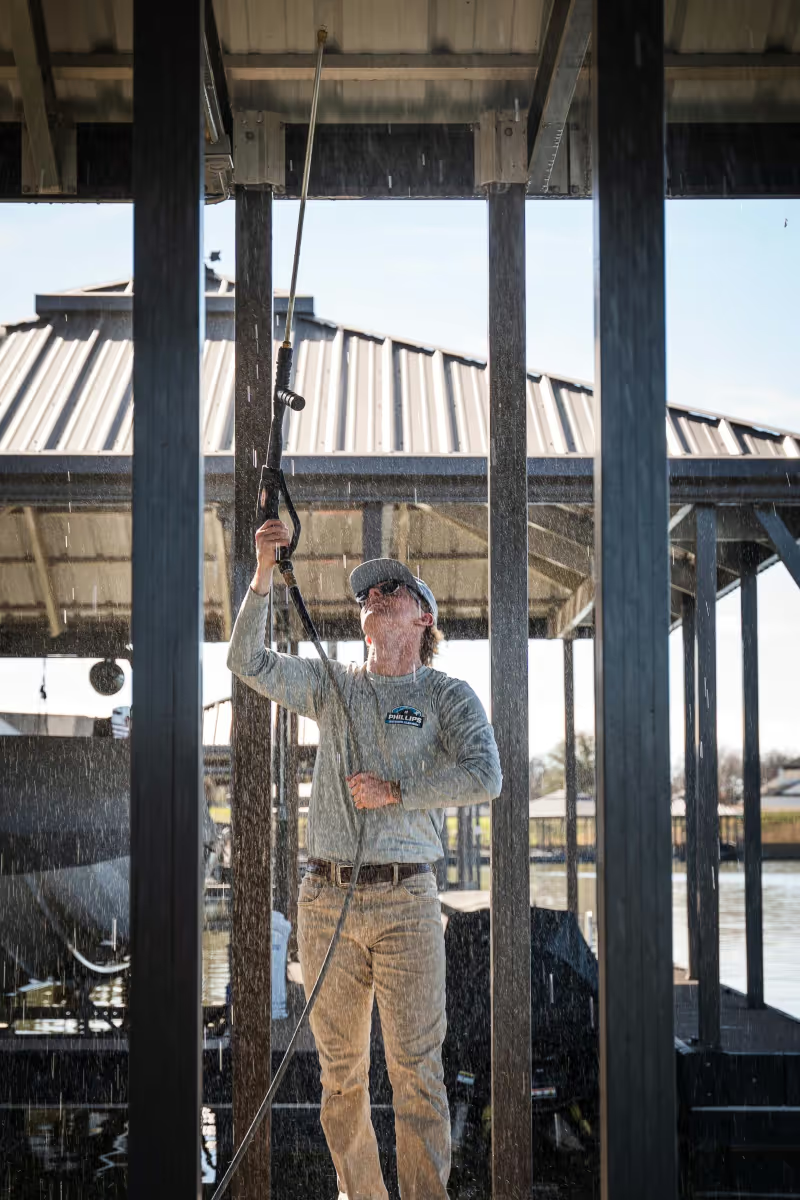
One of the most important reasons to schedule professional dock cleaning before your pre-season safety assessment rather than after is that algae growth and surface grime mask the actual condition of the underlying material. A dock board that looks dark and weathered under a layer of algae may be in reasonable condition once cleaned, or it may reveal concerning deterioration that the algae was obscuring. You can’t accurately assess the structural condition of dock materials through a layer of biological growth and grime.
Scheduling professional cleaning early in the spring, before your first serious safety assessment of the season, gives you the clearest possible view of your dock’s actual surface and structural condition rather than an assessment filtered through the appearance of whatever accumulated over the winter.
Post-Cleaning Inspection Is the Most Informative Assessment
The period immediately after professional cleaning, when all surfaces are clear of the biological growth and grime that accumulated over fall and winter, is the optimal window for a thorough safety assessment. Every board surface, every hardware connection, and every structural element is visible and assessable in a way that isn’t possible when they’re covered by seasonal accumulation. Making your specific pre-season safety walkthrough a post-cleaning activity rather than a pre-cleaning one produces meaningfully more accurate and complete information about your dock’s actual condition.
When to Call a Professional for Structural Concerns
A pre-season safety assessment that reveals soft spots in the walking surface, significant railing instability, major fastener corrosion, or any other structural concern beyond surface algae and cosmetic condition warrants professional structural assessment before the dock sees summer use rather than a monitoring approach that waits to see if the issue becomes more obvious.
The difference in consequence between a structural failure on a dock and a similar failure on a land-based structure is significant. Falls on a dock can result in water entry, contact with dock structure during the fall, and the challenges of water rescue, all of which make the risk profile of unaddressed dock structural concerns meaningfully more serious than equivalent concerns on a land-based structure.
Start Summer With a Dock You Can Trust
The peace of mind of knowing your dock has been professionally cleaned, carefully assessed, and confirmed safe before your family’s first summer visit to the water is worth far more than the effort the pre-season process requires. A dock that’s been looked after properly heading into the season is one you can enjoy fully without the background concern that comes from not knowing whether the structure your family is using is actually in the condition it should be.

Request your boat dock cleaning quote here.

Detail You Can See. Quality You Can Trust.
Contact Us


Find us on


