blog
.avif)
Flat Roof Solar Panels vs. Pitched Roof: Cleaning Differences
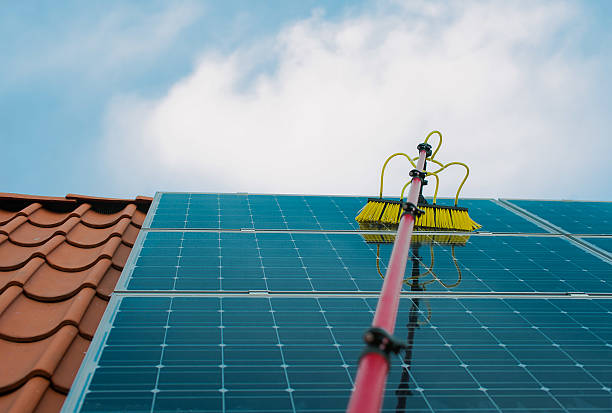
When most people picture residential solar panels, they envision panels mounted at an angle on a pitched roof, angled to catch maximum sunlight. But flat roof solar installations are also present on certain residential and many commercial properties, and the differences between cleaning flat-mounted and pitched-mounted systems go beyond just accessibility, affecting how quickly panels get dirty, what types of buildup accumulate, and how often cleaning is needed.
How Pitched Roof Solar Panel Systems Get Dirty
Gravity Assists Some Self-Cleaning on Pitched Surfaces
One advantage of panels mounted on a pitched roof is that gravity works in their favor to some degree. Rain flowing down an angled panel surface carries loose dust and light debris with it as it runs off, providing a modest degree of natural rinsing that flat-mounted panels don't benefit from equally.
But Pollen and Sticky Debris Still Accumulate
Despite the gravitational advantage for loose dust, pollen, bird droppings, and other sticky or semi-solid materials don't rinse away with rain on a pitched surface any more effectively than on a flat one. These materials require actual cleaning contact to remove, regardless of roof angle.
Debris Tends to Accumulate at the Lower Edge
On pitched panels, gravity causes loose debris to migrate toward the lower edge of each panel, where it can accumulate into a concentrated ridge of grime along the bottom edge that blocks light from the cells immediately above it and can trap moisture that promotes algae growth in that specific area.
How Flat Roof Solar Panel Systems Get Dirty Differently
No Gravitational Assistance for Self-Cleaning
Flat-mounted panels receive no gravitational assistance for debris removal. Every particle that lands on the panel surface stays there until it's physically removed or blown away by wind, which means flat-mounted systems generally accumulate surface buildup faster than equivalently exposed pitched-mounted systems.
Standing Water Creates Additional Mineral Deposit Issues
On flat or very low-pitch surfaces, rainwater can pool rather than running off immediately, leaving behind concentrated mineral deposits as it slowly evaporates. This pooling effect can create more significant hard water spotting on flat-mounted panels than on pitched systems where water drains more freely.
Debris Accumulates Evenly Across the Entire Surface
Without gravity directing debris toward any particular area, flat-mounted panels accumulate grime more evenly across the entire surface, which means the cleaning challenge is distributed rather than concentrated at specific edges as with pitched systems.
Accessibility Differences Between Flat and Pitched Systems
Flat Roof Systems Are Generally More Accessible
Flat roof installations, by definition, don't involve the steep-angle safety challenges of pitched roof cleaning, making the physical process of accessing and moving around the panels during cleaning generally safer and more straightforward than navigating a steeply pitched surface.
But Flat Roof Surfaces Have Their Own Considerations
Flat roof surfaces often use specific membrane materials that require careful foot placement to avoid damage. A professional experienced with flat roof solar cleaning understands how to navigate these surfaces without compromising the roof membrane, which is a consideration that doesn't apply to standard pitched shingle roofs.
How Cleaning Frequency Differs Between the Two Systems
Flat Systems Generally Need More Frequent Cleaning
Given the lack of gravitational self-cleaning assistance and the standing water mineral deposit issue, flat-mounted solar systems typically benefit from more frequent professional cleaning than equivalently located pitched-mounted systems, since the natural accumulation rate tends to be higher without gravity helping manage loose debris between cleaning visits.
Location and Surrounding Environment Still Matter Most
While flat versus pitched is a relevant factor, the dominant influence on cleaning frequency for any system remains the surrounding environment: nearby trees, bird activity, proximity to roads or construction, and local pollen intensity all affect accumulation rate more significantly than roof pitch alone for most residential installations.
Why Professional Assessment of Your Specific System Matters
The differences between flat and pitched systems, combined with the wide variation in surrounding environments and local conditions, make a professional assessment of your specific installation the most reliable way to determine the right cleaning frequency and approach for your particular solar system, rather than relying on generic guidelines that may not reflect your system's actual accumulation patterns.

Get the Right Cleaning Approach for Your System
Whether your solar panels are mounted on a pitched roof or a flat surface, the right cleaning approach is one tailored to your system's specific characteristics rather than a generic method applied uniformly regardless of installation type. Professional cleaning that accounts for your system's particular needs ensures effective maintenance without the risk of damage from approach mismatches.
Detail You Can See. Quality You Can Trust.
Contact Us


Find us on


